Hi friends~
In conversations with clients over the years I’ve attempted to dispel misplaced hope – the belief in the “miracle product,” the “one simple thing,” the “best exercise program” specific supplement, or even hormones that a client read about, saw on the “news”, or social media, or even advised by a professional as the guaranteed key to transformation.
It’s grifting. It’s sleazy, advertising and marketing dressed up to make things look easy, and of course usually a gimmick to sell something. Quick weight loss, “fighting” aging (as if aging were an adversary and not a privilege), or miracle supplements for relieving symptoms of perimenopause – are almost always phony promises. It can be tricky and sometimes it’s hard to spot, especially if a doctor or expert is involved. Women in the perimenopause are real people, with real symptoms, incredibly vulnerable, a humongous demographic, and the target of the biggest grift of all time. There is a f-ton of science here, but a f-ton of money for the industry and shareholders.
No one-size-fits-all.
It ALL depends. Does that sound like a vague cop-out to avoid an answer? Stick with me here…
The topic of recovery for mid-life women came up in a recent convo. It sounds benign, right?
But here we go…it depends. She had read material from a well-known women’s health doctor that perimenopausal women need more recovery. It seems reasonable, but even that seemingly simple concept (and a sweeping statement) could mess with a woman’s head, making her fear failure before she even starts if her sleep tracker reports a bad night. Or the article could have been boosting sales of a sleep aid or supplement, which doctors seem to be hawking relentlessly – and very convincingly.
You own you.
Your body isn’t a math equation; it’s a living organism, unique and different from every other. You are the owner and it makes sense to be aware of how YOU function and how to make the most of your training time. It depends.
Midlife women don’t always need more recovery than men. Research shows that women in general recover faster from exercise due to greater fatigue resistance and faster neuromuscular recovery. However, falling estrogen in perimenopause and menopause, can cause slower recovery, reduced muscle mass, and higher fatigue, possibly requiring more rest during this specific life stage.
So when a client asks me, “What’s the best way to train?” or “How much rest do I need between sets or intervals” My questions follow: For what workout? How long? In what context? What are you training for – and how do you feel, what’s your available time? Again, it depends.
Is consistency possible in the real world?
“Consistency” is a recent buzz word – but what if being consistent is impossible??
That doesn’t account for a 60-hour work week, the stress of raising teenagers, or the physical toll of caregiving.
If a program is advertised as “perfect”, but only if done consistently, and you can’t get to the gym to do it, or if a nutrition plan is advertised as proven and scientific, but recipes and shopping are too time consuming, or the meals aren’t enjoyable…or if you just can’t consistently stick to preparing them – you might feel like a failure and give up, or not even start. So you feel like you’re broken, a failure, and … maybe buy something?
Variety with a purpose and claiming ownership.
My coaching has evolved, and so has my own training. As a certified mat Pilates instructor I use Pilates protocols, along with powerlifting, kettlebells, and dumbbells in my own training, and as a coach. There’s HIIT, Zone 2 cardio, plus power training, and eccentric loading – all tools in the toolbox.
All of these protocols are worth using variously over time to build and maintain muscle.
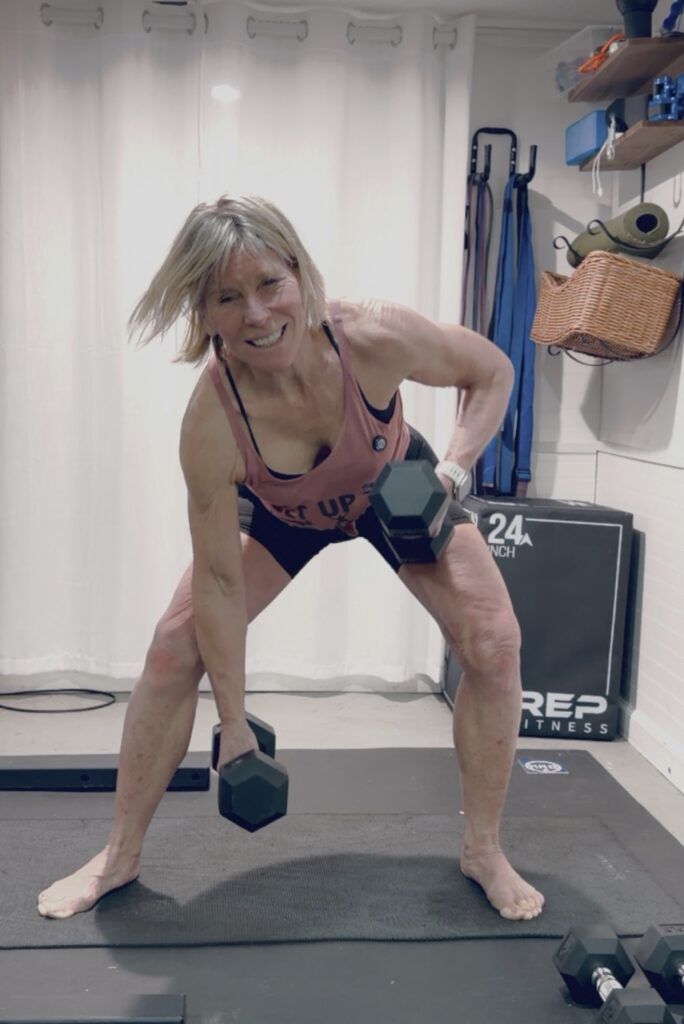
With the theme of variety, I love supersets for time efficiency (pairs of exercises that hit upper and lower body, or opposing muscle groups) with short recovery. Efficient and effective. If you have access to a few pairs of dumbbells, some bands, or tubing, you’re good to go.
Coming soon you’ll have access to Quicksets, including superset workouts. Affordable, you’ll own them, so you can do them on-demand, at home or at the gym, one set at a time, or do multiple rounds, depending upon your time.
My own nutrition isn’t strict, no calorie counting or meal plan. Nutrition coaching for clients is like that – always geared to each individual’s life and personal choices. And of course – it depends!
Look at the reality of your life, allow flexibility, and train like an owner, be kind, but tough enough on yourself so you feel empowered at the gym, in workouts at home, in relationships, and at work.
Strength turns into confidence.
Keep it simple.
Start here.
You rule.
You got this.
X
Polli