Hi Friends~
I hope you’ve had a really good Monday start to your week, wherever you are. Happy June! I’m always so grateful to be able to share my thoughts with you, and I love hearing yours in emails and comments!
Take a look at this meme that’s been making the rounds lately – have you seen it? It’s really been bugging me…
It features two women, a 74-year-old competitive bodybuilder with a chiseled physique; on the other, a 74-year-old woman using a wheelchair. The caption reads, bold and accusatory: “The choice is yours.”
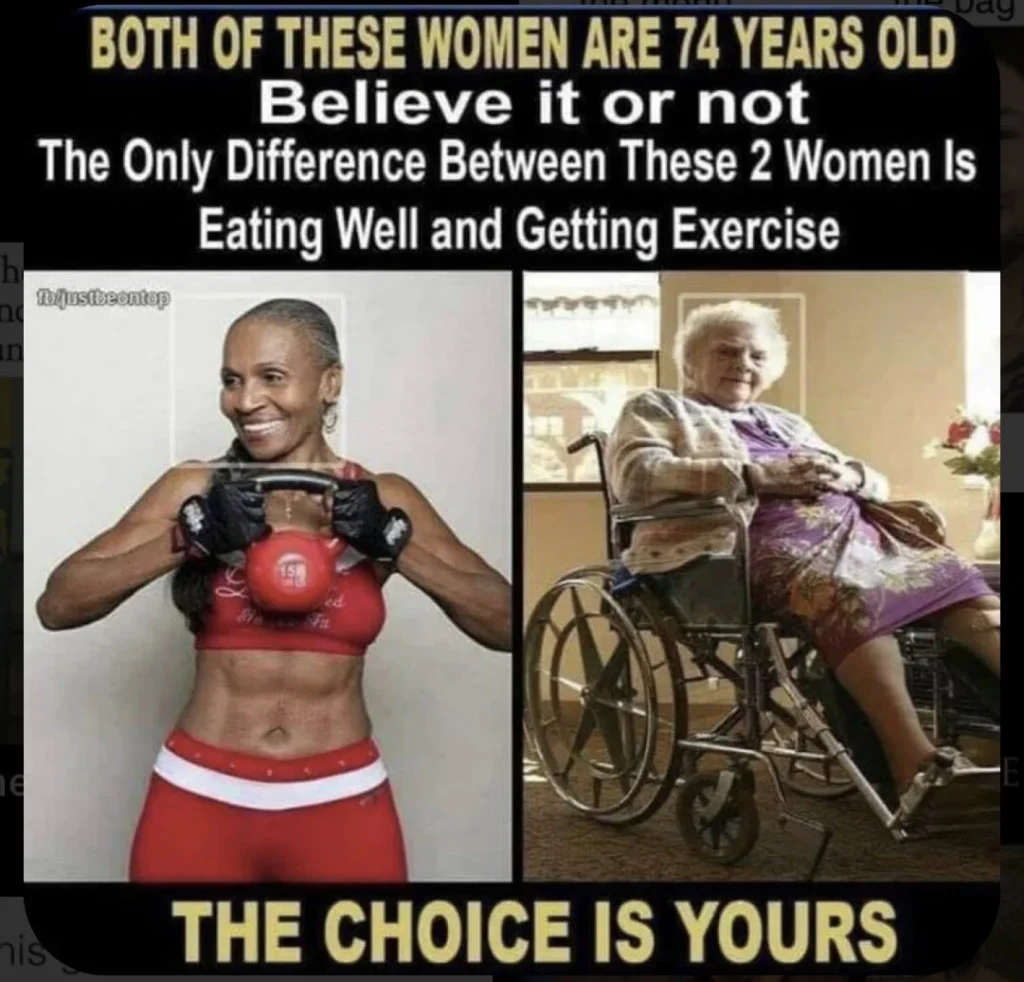
“The only difference between them…”?? Really?
It’s the same oversimplified narrative we constantly get fed on social media. The promise that there is “one simple trick,” “the BEST routine,” or “the ONLY diet.” In this case, the meme implies that if you simply make the right “choice” (which usually involves shelling out money for a specific supplement or a program “doctors don’t want you to know about”), you’ll easily cruise into your mid-70s with a fitness-model body. And if you choose wrong? Well, according to the meme, you’ll end up incapacitated.
It’s clean, it’s dramatic, and it is a total lie. Let’s break down why this kind of black-and-white thinking does far more harm than good.
1. No Amount of “Choice” Fixes Everything
Let’s look at the science: Nutrition and exercise are incredibly powerful tools. They’re our best defenses against a long list of chronic issues, directly reducing the risk factors tied to heart disease, stroke, cognitive decline, type 2 diabetes, and hypertension.
And yes, targeted physical activity and solid nutrition can help manage and mitigate the symptoms of progressive neurological or autoimmune conditions like Parkinson’s, ALS, or MS. But the truth: those diseases will progress regardless of how perfectly you eat or how heavy you lift. No amount of “choosing” will magically halt certain genetic or medical realities. Aging will progress too.
2. The Fitness vs. Happiness Fallacy
Then there’s the emotional implication hidden in the caption: the idea that the bodybuilder is radiantly happy, and the woman in the wheelchair is miserable.
Talk about an oversimplification. The reality is that the grueling, restrictive diet and intense training protocols required for extreme fitness modeling can sometimes be a recipe for mental burnout and physical misery. Conversely, an older adult living with a physical disability might have a deeply rich life, filled with a wonderful support system of family, friends, and meaningful purpose.
3. The Trap of Ableism
This is where the toxic ableism of the fitness industry rears its head. People who are elderly or use wheelchairs or adaptive equipment are not inherently unhappy, nor should it be presumed that they are inactive.
Unfortunately, memes like this reinforce stereotypes that make older adults with disabilities feel completely excluded from accessibility to fitness and strength training. Often, the barrier isn’t a “poor choice” – it’s a literal lack of access to gym spaces, community support, or training protocols adapted specifically for their needs.
Start Where You Are
We need to be able to see the shaming tactics, so successfully employed by the fitness industry.
All types of physical activity should be accessible, encouraged, and celebrated for everyone as we age, whether we are able-bodied or living with a disability. Your fitness journey doesn’t have to look like anyone else’s to be valuable to YOU and your life.
The beautiful thing about strength training is that you can start – or start over – at any age, with whatever body you have today.
No guilt trips. No comparisons.
x
Polli

2 Responses
Great article Polli
Thanks for reading!